21 August 2011

A Modernist Saturday

It was a beautiful, cloudless day last Saturday, which was just the weather I'd been waiting for to visit the Fondation Le Corbusier, which displays Le Corbusier's Maison La Roche and the architect's own apartment at Porte Molitor.

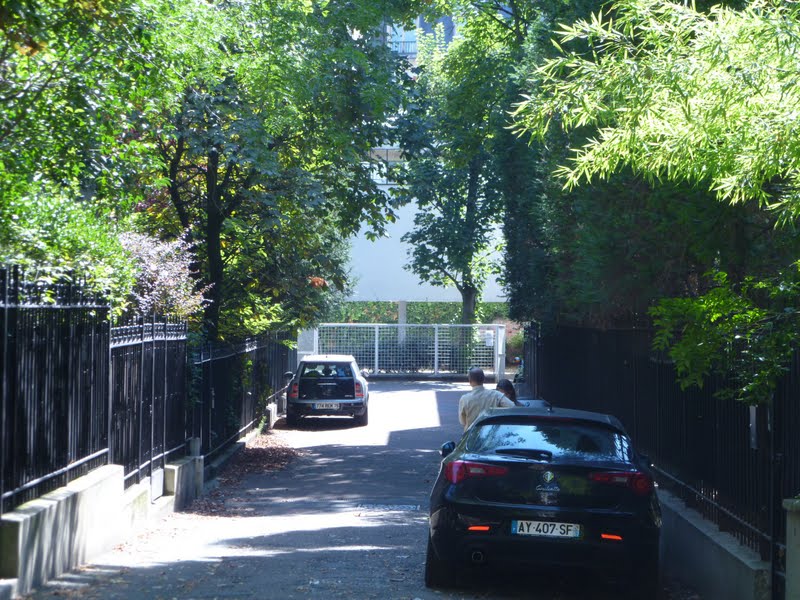
Maison La Roche was built in the mid-1920s for an art collector client at the end of a small cul-de-sac. The house adjoins the Maison Jeanneret which was built for Le Corbusier's brother, and which now houses the Fondation's offices and archives. I didn't get any decent photos of the houses from the outside, but the Maison Jeanneret and part of the La Roche form a single block, which is connected by a full-height entrance hall to the La Roche painting gallery. The gallery is a famous and beautiful volume raised up above the garden on pilotis or small columns; it's airy and bright, with a curved ramp leading up to the client's library. The house was restored with all its original wall colours. 

Le Corbusier did not conceive of buildings to be statically looked at, but rather as large, complex objects to be engaged with. Raising the gallery off the ground and giving the house a roof garden "exposes" all sides of the building; meanwhile, the interior slowly changes appearance as you move through it in what the architect called a "promenade architecturale," where you're offered different views of spaces from a variety of heights and perspectives. This makes it a surprisingly complex house, and it was enjoyable to wander through.


The entrance hall.


11 August 2011

Prague: Too Much is Just Enough

After almost four full days in Prague, I have very few photos taken around town. About five, in fact. I started shooting some colourful, wonderfully-ornamented facades at the start of my first day when I realized that there was colour and wonderful ornamentation all over the city and everywhere you looked. 


09 August 2011

Vienna: Youth Style

A hundred years ago, Vienna was culturally a very exciting place. In reaction to the dominant conservatism of the late Austro-Hungarian Empire, an avant-garde of artists, architects and composers experimented with new aesthetics ranging from Egon Schiele's erotic expressionism to Adolf Loos' upright austerity. This mood was most famously embodied by Jugendstil or "Youth Style," the Central European branch of Art Nouveau which found support from an enthusiastic segment of the bourgeoisie. Thus, so the legend goes, fast-growing pre-WWI Vienna was a crucial laboratory of early Modernism.

Of course, most legends of energetic fin-de-siècle capitals make innovative culture sound like a widespread expression of an enlightened moment, when it was in most places a rather edgy, minor (though not marginal) phenomenon. Thus Frank Lloyd Wright indeed had a thriving practice in contemporaneous Chicago, but most houses in that booming town were still decidedly traditional; and while Paris' metro station entrances are indeed writhingly Art Nouveau, similarly-styled apartment buildings, though found all over the city, need to be distinguished from their more numerous academic-classical neighbours. 

The same can be said for Vienna, but nonetheless I was surprised at how much more of the city is of century-old avant-garde stock, compared with Paris, Chicago, and elsewhere I've seen. (Prague, however, has Vienna beat in this regard, but that's another story...) It seemed hard in the nineteenth-century districts of Vienna to find a street without several Jugendstil buildings, no matter how modest their ornamentation. A number of the finest examples are by Otto Wagner, one of those architects with a rare combination of talent, vision, professional skill and sheer luck, attaining the top of his profession and respected in nearly every way. Wagner's prolific contribution to Vienna was, without exaggeration, frequently evoked by my co-host as we explored the streets: "Here is an Otto Wagner house ... Here is another Otto Wagner house ... These railings were designed by Otto Wagner ... All the metro stations on that line are by Otto Wagner ... This ring of roads was planned by Otto Wagner," and so on.  

For all of Vienna's beautiful old central district and pompous nineteenth-century monuments, then, it has enough Jugendstil to make the city appear elegantly progressive.

These are some well-known buildings mixed in with some of the other random details that caught my eye. This is another long post, by the way.


Here's a paired apartment building by Otto Wagner. The stair hall's stair treads are surprisingly gentle to climb.


04 August 2011

Dandytown

Vienna has a refined, dandyish streak, as you can see in these exquisite storefronts in the central shopping district. (Most of these are, naturally enough, jewellers.)


Vienna 2

Here are some more pictures of various places in Vienna. Be warned that this is another long posting.

A traditional Viennese hof or court.